
How to Hunt Standing Corn Fields: Tactics, Scouting Tips & Stand Placement
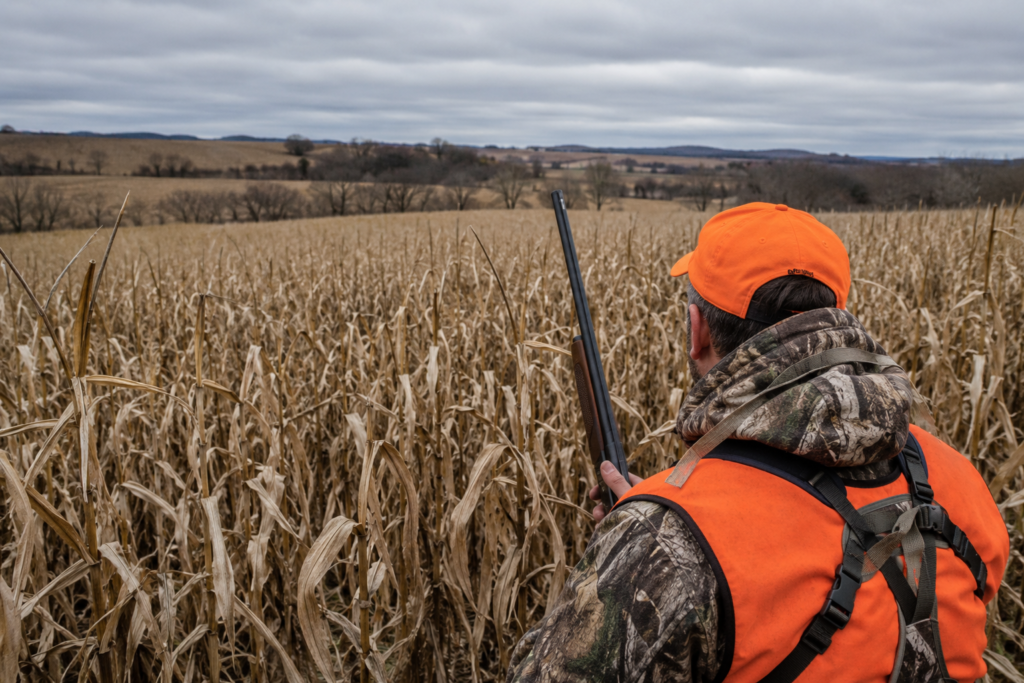
Standing corn is one of the most underutilized and misunderstood hunting environments in whitetail country. When farmers leave fields standing into archery and firearm seasons, those towering green walls of corn become a deer magnet — offering dense bedding cover, reliable food, and nearly impenetrable escape routes all in one place. Mature bucks that disappear from camera grids in August often haven’t gone far; they’ve simply slipped into the corn and set up shop. Learning how to hunt standing corn fields effectively means rethinking your scouting approach, your stand placement, and the way you enter and exit the field — but the payoff can be enormous. This guide breaks it all down, from early-season scouting through post-harvest late-season tactics.
How to Scout Standing Corn Fields
Scouting standing corn requires a different mindset than scouting timber or open fields. You generally cannot walk through the crop without alerting deer or leaving a scent trail that will educate every animal in the area. The good news is that most of the information you need is available from the outside — if you know what to look for.
Walk the Perimeter: What to Look For
Start by walking the edges of the corn field, ideally in the days before season opens. Look for the following sign along the perimeter rows and in the timber or brush adjacent to the field:
- Trails entering and exiting the corn: Deer create defined lanes in and out of the crop. Look for matted or broken stalks, hoof prints in soft soil, and dark, worn paths at the field edge.
- Rubs and scrapes near the field edge: Bucks staging near corn before moving to other areas will often rub saplings along the edge timber.
- Corner points and timber fingers: Any place where the tree line juts into the field, or where the corn corners sharply, funnels deer movement. These are your priority stand locations.
- Drainage channels and low spots: Creeks, ditches, and swales that run through or alongside corn fields create natural travel corridors that deer use regularly.
- Scattered cobs or downed stalks inside the perimeter rows: Signs of active feeding just inside the field edge indicate deer are using specific sections of the crop for both food and cover.
Bring a quality pair of binoculars and glass the field edges from a road or elevated position whenever possible. Watching feeding activity during low-light periods can reveal travel lanes and preferred entry/exit points without requiring you to set foot inside the field.
Trail Cameras and How to Deploy Them in Corn Country
Trail cameras are invaluable in corn country, but placement is everything. Avoid walking deep into the field to hang cameras — the scent intrusion isn’t worth it in most cases. Instead, focus your cameras on high-percentage perimeter locations:
- Field corners: Corners concentrate movement from multiple directions and are consistently the most productive camera locations in standing corn environments.
- Timber-to-corn transition funnels: Anywhere a narrow band of trees or brush connects a woodlot to the corn field will see regular traffic.
- Established trails entering the field: Once you’ve identified a well-worn trail, a camera set 5–10 yards off the field edge (facing the trail, not into sun) will capture high-quality images with minimal intrusion.
- Drainage crossings: Ditches and waterways that deer must cross to reach the corn are natural choke points.
Set cameras to video mode or rapid-burst photo mode with a short trigger interval during the early season. Pay close attention to time stamps — deer moving into corn in the last 30 minutes of shooting light versus deer entering two hours before dark represent very different hunting scenarios. A buck showing up consistently in daylight at a field corner is a killable deer; one arriving only after dark is a project for the rut or a location change.
Using Maps and Apps to Scout Before You Go
Before you ever set foot on a property, spend 30 minutes on a mapping app like onX Hunt or BaseMap studying the aerial and satellite imagery. Zoom in on the corn field and identify:
- Timber fingers or brushy peninsulas that extend into or alongside the corn
- Drainage channels, creek beds, and low-lying corridors
- Fence lines, hedgerows, and adjacent cover that deer use to move between bedding and feeding areas
- Potential stand access routes that allow you to approach without crossing deer travel lanes
- Road positions or elevated terrain where you can glass the field remotely
Satellite imagery taken during or after harvest season from a prior year will show you the field’s structure clearly. Identify pinch points and funnel locations on the map first, then confirm them on foot.
Timing and Seasonal Considerations
Standing corn doesn’t stay the same all season, and neither do the deer using it. Understanding how and when deer use corn at different phases of the season will help you place your efforts where they’ll do the most good.
Early Season: Corn Fully Standing
In the early archery season — typically September through mid-October in most of the whitetail range — corn fields are at their fullest. Stalks are 7–10 feet tall, the canopy is dense, and visibility inside the field is near zero. Deer are using the corn heavily for both food and thermal cover. Mature bucks that are otherwise nocturnal may spend large portions of the day bedded inside the field, never presenting an opportunity to hunters watching distant food plots or timber stand locations.
During this phase, your best opportunities come at field edges during the last hour of shooting light and the first hour of the morning. Target corners and funnels where deer enter and exit. Bow hunters who can get within 20–30 yards of a well-used entry trail are in business. The key challenge is keeping your entry and exit clean — more on that below.
When the Farmer Cuts: Opportunities and Patterns
Corn harvest is one of the most significant events in the fall hunting calendar for agricultural deer hunters. When a field is cut — whether partially or all at once — deer that were bedding and feeding inside the corn are displaced. This creates a dramatic, short-window spike in movement as deer relocate to nearby timber, switch to adjacent standing corn, or begin visiting the cut rows to clean up dropped ears.
If you know a farmer is planning to cut within the next few days, prioritize your hunts for the evening of the cut or the morning immediately after. Set up on the timber edge bordering the cut field, or cover the remaining standing corn if only a portion has been harvested. The transition line between cut and standing corn becomes an incredibly productive funnel. Watch for deer staging in the standing corn and stepping out along the edge to feed on exposed ears in the cut rows.
Building a relationship with the landowner or farm operator and asking them to notify you before harvest begins can pay enormous dividends. A simple text message saying “cutting the east field tomorrow” is worth more than weeks of scouting in some situations.
Late Season and Winter Stubble Hunting
After harvest, the hunting dynamic shifts completely. Deer lose their primary cover and must consolidate near timber, brushy draws, and any remaining standing cover. However, leftover ears and waste grain in the stubble draw deer into the cut fields during daylight, especially in cold weather when caloric demands are highest. Late season corn stubble hunts — particularly during cold snaps in December and January — can produce some of the best daylight deer activity of the entire year.
Set up elevated stands or ground blinds near the transition between cut fields and adjacent timber. Watch for trails in the snow (where applicable) and focus on the southern and eastern edges of fields that offer solar warming during afternoon hunts. During the late season, deer movement is driven almost entirely by food and thermoregulation — predictability goes up significantly.
Tactics: Where to Set Up and How to Position Stands and Blinds
Hunt the Corners, Funnels, and Timber Noses
This is the single most important tactical principle in standing corn hunting: find the funnel and sit on it. Deer don’t randomly exit a corn field — they move to specific locations consistently, and those locations are almost always associated with some change in the field’s geometry or adjacent cover.
A corner of the field where two field edges meet concentrates deer from multiple approach directions. A timber finger that juts into the field gives deer a covered approach lane that they use almost exclusively. A gap in a fence line or a low spot in a berm creates a natural pinch point. In every case, the deer’s desire to use cover while transitioning in and out of the corn creates these funnels — and that’s where you want your stand or blind.
For most setups, you want to be positioned 10–40 yards from the field edge, depending on your hunting method. Bow hunters should aim for the close end of that range; firearm hunters can work from further back. Position yourself downwind of the expected approach and within range of the deer’s most likely travel path, not directly on it.
Edge Setups: Elevated Stands vs. Ground Blinds
Both elevated stands and ground blinds have a place in corn field hunting, and each has distinct advantages.
Elevated stands — ladder stands, hang-on stands, or climbing sticks with a platform — give you a broader view of the field edge and allow you to see deer approaching before they reach your position. They also help keep your scent above deer travel lanes. The downside is that setup and climbing require noise discipline, and stands set on open field-edge trees can be spotted by educated deer.
Ground blinds are often the better choice for corn country, particularly for bow hunters. A compact hub-style blind placed at the edge of a timber funnel, or even just inside the first row of corn, can be incredibly effective. Ground blinds allow you to position inside the cover, reduce your skyline profile, and block your movement and silhouette completely. If you’re using a ground blind, brush it in with cornstalks and natural vegetation, set it up several days before your first hunt to let deer acclimate, and make sure your shooting lanes are cleared and ranged before the hunt.
Regardless of your setup type, orient your blind or stand so that your back is to solid timber or cover and your face is toward the corn or across the predominant wind. Never set up so your scent blows directly into the field.
Hunting Inside the Corn: When to Go In and When to Stay Out
Hunting inside a standing corn field is possible, but it demands a higher level of discipline and should only be attempted when you have a clear tactical reason — such as a camera showing a mature buck using an interior lane that never touches the field edge.
If you do hunt inside the corn, keep these principles in mind:
- Pre-walk your lanes before the season. Identify the deer trails running between rows, mark them on your GPS, and clear any debris or obstacles that would cause noise during entry.
- Use a small, low-profile blind or a simple stool and natural vegetation to break up your outline.
- Step-by-step entry discipline: Move slowly, listen before each step, and never bulldoze into the field. One brushed stalk can alert every deer within 100 yards.
- Keep shot distances short. Interior corn hunting is a close-quarters proposition — 10 to 20 yards is common. Make sure your shooting lane is clean before you squeeze the trigger or release an arrow.
- Have a clear exit plan. Know exactly how you’ll get out without contaminating the area for future hunts, and plan your exit for midday when deer have moved away from active feeding lanes.
Coordinated Drives and Two-Hunter Setups
Where legal and ethical, two hunters can work a standing corn field in a coordinated fashion. One hunter covers a field corner or downwind exit while the second slowly walks a predetermined lane through the corn, pushing deer toward the waiting hunter. This tactic works best in smaller fields and during firearm seasons when a short drive through a strip of corn is practical.
Communication is critical. Both hunters must know exact positions, shooting zones, and safe zones before any movement begins. Never shoot in the direction of another hunter, even if a deer is running that way. A two-way radio or cell phone communication plan — established before the hunt — is strongly recommended. Check your state’s regulations on organized drives, as rules vary.
Entry, Exit, and Scent Control
Soft-Entry Routes and Noise Discipline
Your entry and exit from a corn field stand can make or break the entire season. Deer that pattern hunters entering and exiting from a specific direction will abandon that area quickly — often permanently during that season.
Follow this entry sequence for consistent success:
- Park away from the field. Use a farm lane, road shoulder, or distant parking area so your vehicle and door noise don’t alert bedded deer.
- Approach via established farm tracks, ditch banks, or timber. Avoid walking through standing corn whenever possible — the noise is difficult to manage and the scent imprint lasts for hours.
- Stop and listen at the field edge. Before stepping into your setup area, pause for 2–3 minutes. Listen for deer movement, feeding sounds, or any indication that animals are nearby.
- Move slowly and step deliberately. If you must brush through any vegetation, move each stalk aside gently rather than pushing through.
- Use pre-dawn timing when possible. Arriving well before first light allows deer to settle back into their patterns before shooting light begins.
Exit your stand the same way — slowly and quietly, ideally at midday when deer activity is lowest, or when wind conditions will carry your scent away from the field rather than across it.
Wind and Scent Management in Tall Corn
Corn fields create complex microclimates and wind patterns that differ significantly from open fields or timber. Tall stalks channel, deflect, and swirl wind in unpredictable ways. Thermal currents that rise in the morning and fall in the evening are amplified along field edges.
A few principles to guide your scent management in corn country:
- Always confirm wind direction at the field edge before settling in, not just at your truck or a distant location.
- Favor crosswind setups where your scent blows parallel to the field edge rather than into or out of the corn.
- Use scent-elimination sprays on boots and outer clothing, but don’t rely on them exclusively — no spray eliminates 100% of human odor.
- In the early season, thermals rising off warm fields during morning hunts can carry your scent unpredictably. Err on the side of caution and hunt field edges during periods of steady, consistent wind.
Gear, Stands, and Shot Considerations
Recommended Gear for Corn Field Hunting
The right gear makes a significant difference when hunting standing corn. Here’s what to prioritize:
- Compact ground blind: Look for low-profile hub blinds in the 58–64 inch height range. The Double Bull Deluxe or Primos Double Bull SurroundView are popular options that balance concealment with shootability. Ensure the blind is dark-sided to eliminate silhouette inside the blind.
- Lightweight hang-on or climber stand: If using an elevated stand along the timber edge, lightweight aluminum options from Summit or Lone Wolf minimize pack-in noise and setup time.
- Rangefinder: A quality laser rangefinder (Vortex Ranger, Sig Sauer Kilo series) is essential for marking shooting lanes in corn where distances are deceptive.
- Compact binoculars: 8×32 or 10×32 binoculars are ideal for corn edge hunting — powerful enough to identify deer in low light without the bulk of larger glass.
- Quiet, low-snag footwear: Rubber knee boots or rubber-soled hunting boots minimize scent left on approach routes and reduce the chance of snagging dried cornstalks during entry. Gaiters help in wet or dew-covered conditions.
- Red-light headlamp: Use red or green LED headlamps for pre-dawn entry. White light is visible to deer and will blow your cover before the hunt starts.
- Compact pruning shears: Useful for quietly trimming shooting lanes at your ground blind location without creating excessive noise or disruption.
Shot Placement and Typical Shooting Windows
Corn field hunting almost always means short shooting distances and limited shooting lanes. Expect most shots — especially with a bow — to present at 15–30 yards, often with stalks partially obscuring the deer’s body. This demands patience and discipline.
- Wait for a clear broadside or quartering-away shot with a fully unobstructed lane before releasing. A single corn stalk between your broadhead and the deer’s vitals can deflect an arrow enough to cause a non-lethal wound.
- With firearms, low-velocity or fragmenting projectiles may be deflected by dense stalks at close range — use premium, controlled-expansion ammunition and wait for a lane that’s genuinely clear.
- Pre-range all potential shooting lanes before the hunt. Place small sticks or surveyor’s tape at 10, 20, and 30 yards along each lane so you aren’t guessing in low light.
- If a deer is wounded and runs into the corn, mark your shot location with GPS immediately, wait at least 30–60 minutes before following (longer for marginal hits), and bring a second hunter if possible. Blood trails in corn are difficult to follow and deer can travel surprising distances inside a field.
Legal, Landowner, and Ethical Considerations
Permission and Trespass: Get It in Writing
The vast majority of standing corn fields exist on private land. Never hunt private land without explicit permission from the landowner, and in many states, hunting posted land without permission constitutes criminal trespass.
While a handshake is a start, getting permission in writing is best practice everywhere and legally required in some jurisdictions. A simple written agreement should include:
- Landowner name, address, and contact information
- Hunter name and contact information
- Specific parcel or field description (legal description, acreage, or map reference)
- Season dates and legal hunting methods covered
- Any restrictions (no vehicles in fields, specific entry/exit points, guest policies)
- Landowner and hunter signatures and date
Check your state DNR or wildlife agency website for any specific requirements regarding written permission on posted private land. States like Indiana and North Carolina have detailed guidance on private land access that is worth reviewing before the season.
Crop Damage, Game Retrieval, and Farm Equipment Coordination
Farmers invest enormously in standing corn crops, and your access depends on being a respectful, communicative partner. Follow these principles:
- Minimize entry into the crop. Don’t trample rows unnecessarily during setup, scouting, or retrieval.
- Coordinate with the farmer around harvest schedules. Never be in a field during active combining or tractor operations — large farm machinery creates genuine safety hazards and operators may not see a hunter in the field.
- Plan your game retrieval route before the hunt. Know how you’ll get a deer out of the field without driving a truck through standing rows unnecessarily. Ask the landowner about preferred access routes for retrieval.
- Never shoot toward farm equipment, outbuildings, roads, or livestock areas, regardless of what a deer is doing.
- Follow your state’s regulations on carcass disposal — field dressing and leaving entrails in agricultural fields is typically legal but should be discussed with landowners who may have preferences.
Safety: Blaze Orange and Stand Safety
Safety requirements in standing corn fields are no different from any other hunting environment — but the dense cover adds unique hazards worth highlighting.
Blaze orange requirements vary significantly by state and season. During firearm deer seasons, most states require hunters to wear a minimum amount of hunter orange (typically 400–500 square inches visible on the upper body). Some states — like Minnesota — require orange during all deer seasons including archery. Others, like Texas, have no mandatory orange requirement for most hunting. Always check your specific state and season regulations before heading afield, and when in doubt, wear orange regardless of the legal requirement. The dense visual environment of a corn field makes it especially easy for other hunters, farm workers, or shooters to misjudge positions.
Additional safety guidelines:
- Use a certified safety harness any time you hunt from an elevated stand. Falls from tree stands cause more hunting fatalities and serious injuries than any other single cause. The Tree Stand Safety Awareness Foundation recommends wearing a full-body harness from the moment your feet leave the ground.
- Communicate your location. Tell a family member or hunting partner exactly where you’ll be hunting, including the field location and your expected return time.
- Never enter a field during active harvest. Combines and tractors move quickly and create blind spots — stay out of fields when machinery is operating.
- Unload firearms before climbing into or down from stands, and use a haul line to bring bow or firearm to your elevated position.
Pre-Hunt Checklist: Standing Corn Field Hunting
- ✅ Confirm written landowner permission covering the specific field and season dates
- ✅ Check your state DNR regulations — blaze orange requirements, season dates, and any special rules for agricultural land
- ✅ Scout the field perimeter and identify corners, funnels, and timber transitions using onX or satellite imagery plus on-foot confirmation
- ✅ Deploy trail cameras at field corners and funnel points 1–2 weeks before your first hunt; check them remotely if possible
- ✅ Confirm harvest schedule with the landowner and plan your highest-priority hunts around cut timing
- ✅ Set up ground blind or stand at least 3–5 days before hunting; brush in ground blind with local vegetation
- ✅ Pre-walk and clear shooting lanes; range and mark distances with stakes or tape
- ✅ Plan and walk your soft-entry route; identify parking location away from the field
- ✅ Pack rangefinder, red-light headlamp, quiet footwear, safety harness, and communication device
- ✅ Check wind forecast the night before; confirm your setup is on the correct side for predicted conditions
- ✅ Mark your stand/blind location in GPS for post-harvest game retrieval reference
- ✅ Notify a family member or partner of your location and expected return
Frequently Asked Questions
Should I hunt inside the corn field or stick to the edges?
For most hunters, edges and funnels produce more consistent success with far less risk of alerting deer or contaminating the hunting area. Hunting inside the corn is a valid tactic when cameras confirm a specific interior lane is being used by a target deer, but it requires more discipline, more preparation, and a clear entry/exit plan. If you’re new to corn field hunting, start on the edges and work inward only when you have a specific reason to do so.
How close to the farmer’s equipment is it safe to hunt?
The simple answer is: don’t hunt when the equipment is in the field. Coordinate directly with the farm operator about their harvest schedule and be completely clear of the field during any active tractor or combine operation. Not only is this a hard safety rule, active machinery changes deer behavior dramatically and will eliminate any productive hunting opportunity anyway.
What if the corn is still standing in late December?
Late-standing corn is a significant advantage. Focus on edges and funnels as deer move between the standing corn and any nearby food sources (bean stubble, food plots, winter wheat). Expect deer to be using the corn heavily for thermal bedding cover in cold weather. Shooting lanes will still be limited, so patience and short-range shot setups remain the priority. Also verify that your state’s season is still open and that all applicable regulations — including blaze orange and firearm type — are being followed.
What’s the best bow setup for hunting standing corn?
A shorter axle-to-axle bow (28–32 inches) is easier to maneuver in tight quarters inside a ground blind or at close shooting lanes along a field edge. Set your sight pins for close distances — 10, 20, and 30 yards — and practice shooting from a seated or crouched position in low-light conditions before the season. Mechanical broadheads are popular for corn field hunting given the typically short distances, but fixed-blade heads are more forgiving of minor stalk deflection at longer distances.
How do I recover a deer that runs into standing corn after the shot?
Mark your exact shot location immediately using your GPS app (onX and BaseMap both allow you to drop a pin in seconds). Note the direction the deer ran and the last point you saw or heard it. Wait before following — 30 minutes minimum for a confirmed double-lung hit, 60–90 minutes or longer for a shoulder or liver hit. When you do enter the corn, move methodically and mark the blood trail with surveyor’s tape at each confirmed sign. Bring a second hunter if available, and work parallel lanes to cover more ground. In tall standing corn, look up — sometimes deer that expire in corn can be found by watching for moving stalks or spotting them from a slight elevation.
Putting It All Together
Standing corn fields are one of the most productive and exciting environments in whitetail hunting, but they demand a thoughtful, disciplined approach that differs from conventional timber or open-field hunting. Scout the edges first, focus your stands on corners and funnels, manage your entry and exit with surgical precision, and build a respectful relationship with the landowners who make access possible. Time your best hunts around the harvest window, follow every applicable safety regulation — including blaze orange requirements for your state and season — and practice patience when shots present at close range in tight cover. Hunters who commit to learning the nuances of how deer use standing corn will find it becomes one of their most reliable and rewarding setups each fall.